
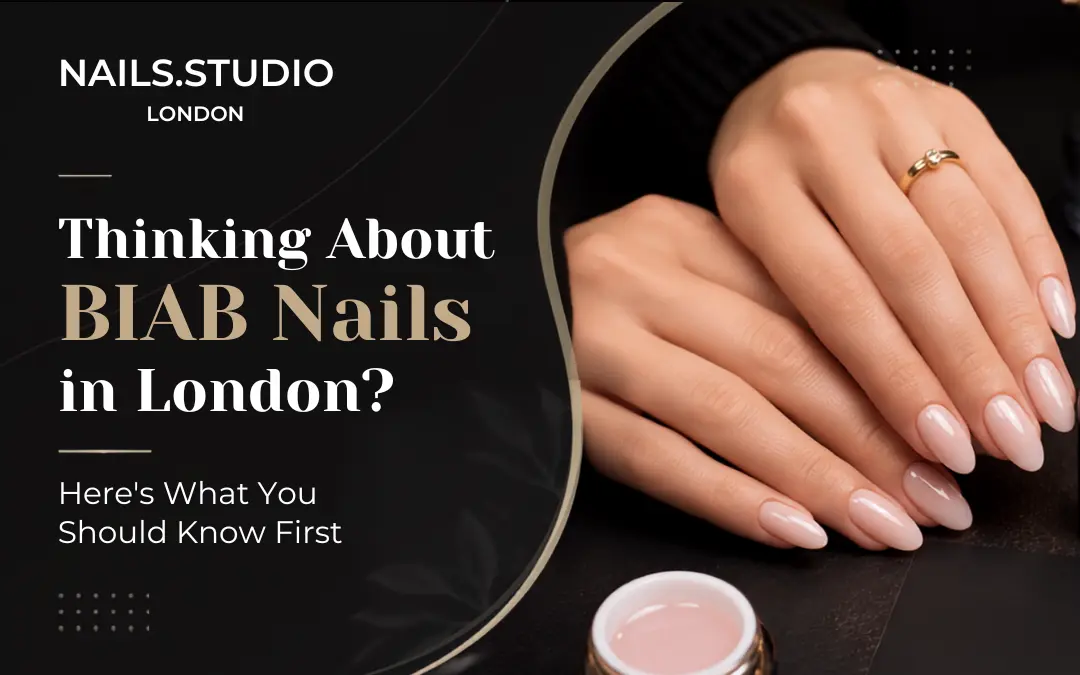
If you’ve been scrolling through nail content and keep seeing BIAB mentioned, you’re not alone. BIAB nails in London searches have grown significantly over the past couple of years as more people move away from acrylics and look for something that gives them length, strength, and longevity without the damage that comes with heavier nail systems.
But there’s also a lot of confusion about what BIAB actually is, how it differs from regular gel, who it’s actually suitable for, and what to look for in a technician. This guide covers all of it — so you can book your first BIAB appointment knowing exactly what to expect.
BIAB stands for Builder In A Bottle. The name describes what it does — it’s a builder gel that comes in a bottle (as opposed to traditional hard gel that comes in a pot and requires a separate brush). The formula is significantly thicker than regular gel polish, which means it can add real structure and length to the nail rather than just sitting on the surface as colour.
The product was originally developed and popularised by The Gel Bottle Inc., though several other brands now produce their own versions of builder-in-a-bottle formulas. At its core, BIAB is a hybrid between a gel polish and a hard gel — thin enough to be applied like a polish, but strong enough to function like a builder.
This is the question most people have when they first come across BIAB, and it’s a fair one because the application looks similar from the outside.
The key difference is viscosity and structural capability. Regular gel polish is designed to add colour and shine — it sits on the nail surface but doesn’t add meaningful strength or thickness. A standard gel manicure on a weak or brittle nail will still chip and break because the underlying nail hasn’t been reinforced.
BIAB gel is formulated to be substantially thicker. When applied and cured, it creates a hard layer over the natural nail that adds genuine structure — effectively encasing the nail in a protective shell that gives it both strength and some additional length or thickness if needed. This is why BIAB nail extensions can be created using the formula, and why BIAB manicures are often recommended for clients with weak, bitten, or damaged nails that regular gel doesn’t help.
The practical result: a BIAB manicure typically lasts three to four weeks compared to two to three weeks for gel polish, and it holds up noticeably better to day-to-day physical activity.
This is where BIAB has genuinely changed the conversation around nail extensions. For years, acrylic was the default choice for anyone wanting added length — but acrylic comes with real trade-offs.
Acrylic nails require a monomer liquid (which has a strong smell and is a known sensitiser with repeated exposure), need significant filing and buffing to blend, and removal typically involves aggressive soaking or mechanical filing that can leave natural nails thin and damaged. Many people who wear acrylics long-term end up with significantly weakened natural nails underneath.
BIAB works differently. Because it’s a gel-based product, it soaks off relatively gently (with the correct technique — more on that below), doesn’t require the same level of aggressive filing during application, and is formulated to be more flexible and nail-compatible than rigid acrylic. The natural nail underneath tends to be in considerably better condition after BIAB removal than after acrylic removal.
The trade-off is that BIAB doesn’t produce quite the same extreme length or rigidity as a full acrylic set — it’s better suited to natural-to-medium extensions than to very long, dramatic nails. For most clients looking for healthy, strong, natural-looking extensions, BIAB is the better long-term choice.
One of the reasons BIAB nails treatment appointments in London have become so popular is that the treatment genuinely suits a wide range of clients — not just those who want extensions.
Clients with weak or brittle nails often find BIAB transformative. The builder gel layer protects the natural nail from breaking and allows it to grow underneath, which is why many people start BIAB specifically as a nail-strengthening treatment rather than because they want extensions.
Nail biters frequently turn to BIAB because the hard coating makes the habit more difficult and protects the nail as it grows, often breaking the habit over the course of a few infill cycles.
Clients who want extensions without acrylics — whether because of sensitivity to acrylic monomers, concern about nail health, or simply preferring a more natural look — find BIAB a comfortable alternative.
Regular gel wearers who find their nails are constantly chipping or breaking between appointments often switch to BIAB and find the additional structure makes a significant difference to wear time.
BIAB is generally not recommended during pregnancy (speak to your GP if you’re unsure) or for clients with specific gel allergies or sensitivities. If you have a history of reactions to nail products, mention this before your appointment.
Understanding the process helps set realistic expectations — particularly around how long it takes and why the appointment is structured the way it is.
Nail prep comes first and takes longer than most clients expect. Cuticle work, nail shaping, dehydration, and light buffing all happen before any product is applied. This is not time being wasted — it’s what the longevity of the result is built on. A BIAB application that skips or rushes prep will start lifting from the edges within a week.
For BIAB nail extensions, a customised nail tip is selected and applied to add the desired length before the builder gel is sculpted over the top. The tip choice depends on your natural nail shape, your desired length, and what the technician recommends after assessing your natural nail.
For BIAB manicures (no extension tip, just the builder gel over the natural nail), the process is faster — the builder gel is applied directly over the prepared natural nail in one or two layers, then cured under a UV or LED lamp.
Colour and finish — BIAB works beautifully as a base for gel polish, so colour, chrome powder, or nail art can all be applied over the top once the builder layer is cured. If you want a clear or natural finish, the BIAB layer can be buffed smooth and left with just a top coat for a clean, strengthened look.
A full BIAB nail extension appointment takes approximately one hour and 45 minutes. A BIAB overlay (no extensions) is typically 60 to 90 minutes.
This is an area where a lot of first-time BIAB clients are caught off guard. BIAB nails aren’t just maintained by removing and reapplying — they’re infilled.
As your natural nail grows, a gap appears at the base of the BIAB layer. An infill appointment addresses this by cleaning up the grown-out area, applying fresh builder gel to fill the gap, and refreshing the shape and colour. Infills are typically done every three to four weeks and are shorter appointments than the original application — usually 60 to 75 minutes.
The benefit of the infill system is that it’s better for your natural nail than repeated full removal and reapplication. Your nail isn’t being disrupted at every cycle — it’s being maintained progressively, which allows it to grow in better condition.
Not all BIAB applications are equal, and the quality of your result depends heavily on the skill of the technician.
The things worth paying attention to when choosing where to book:
Prep time. A reputable technician spends genuine time on nail preparation before applying any product. If an appointment is advertised at 45 minutes for a full set of BIAB nail extensions, that’s not enough time to do the job properly.
Product knowledge. Your technician should be able to explain what products they’re using and why. If they can’t distinguish between different builder gel formulas or don’t have a clear answer about removal technique, that’s worth noting.
Photos of their actual work. Look at portfolio images from the specific technician you’re booking with, not just the salon’s general Instagram. Consistency across their sets tells you a lot about their technique.
Removal approach. Ask how they remove BIAB. The correct answer involves soaking, not aggressive filing or force. Improper removal causes the nail damage that gives BIAB a bad reputation in some circles.
For best BIAB nails in London results, you want a salon that takes the preparation as seriously as the application — because that’s where the difference between a three-day lift and a three-week result is made.
Once you leave the salon, what you do (and don’t do) in the first 24 hours matters more than most people realise.
Avoid water exposure for the first few hours after your appointment — particularly hot water, which can affect how the gel has fully set. The product cures under the lamp, but the full hardening process continues slightly after you leave.
Wear gloves for household tasks — washing up, cleaning, and gardening are the three biggest causes of early lifting. It’s not about the gel being weak; it’s about sustained contact with water and chemicals working at the edge seal over time.
Don’t pick or force lift any edge that starts to lift. If a small corner starts to come away, leave it and contact your salon — picking accelerates the lifting across the rest of the nail and causes the most nail damage associated with gel and BIAB wear.
Moisturise your cuticles daily. Dry cuticles contract and pull at the edge of the product, which is a common cause of lifting at the proximal edge. A good cuticle oil applied regularly keeps the skin supple and extends the life of your set.
If you’re ready to try BIAB nails in London for the first time, or you’ve had disappointing results elsewhere and want to experience what a properly done BIAB set actually looks and feels like, Nails Studio London’s team of expert technicians is here to help.
Every appointment starts with a consultation — we’ll look at your nails, talk through what you’re after, and make sure we’re recommending the right approach for your specific nail type and lifestyle.
With proper prep, application, and aftercare, BIAB nails typically last three to four weeks before an infill is needed. Wear time varies depending on your nail growth rate and how hard your nails work day to day.
Applied and removed correctly, BIAB is one of the gentler nail systems available. The damage associated with some BIAB experiences usually comes from improper removal — forcing or peeling the product rather than soaking it off.
Yes. BIAB is frequently used as a treatment for bitten or very short nails. The builder gel creates a hard coating that protects the nail as it grows and makes it more difficult to bite. Many clients start BIAB specifically for this reason and find it helpful over the course of a few months.
BIAB is a type of gel overlay — the distinction is in the product formula. BIAB uses a thicker, harder-setting builder gel that adds more structure than standard gel overlays. The terms are sometimes used interchangeably, but the product quality and result can vary significantly.
Every three to four weeks is typical. Leaving it longer than four weeks means the grown-out gap becomes significant and the structural integrity of the extensions is compromised.
Yes — BIAB works equally well as an overlay on short natural nails or as a base for extensions. Many short-nail clients start with an overlay to strengthen the natural nail, then gradually build length over subsequent appointments.